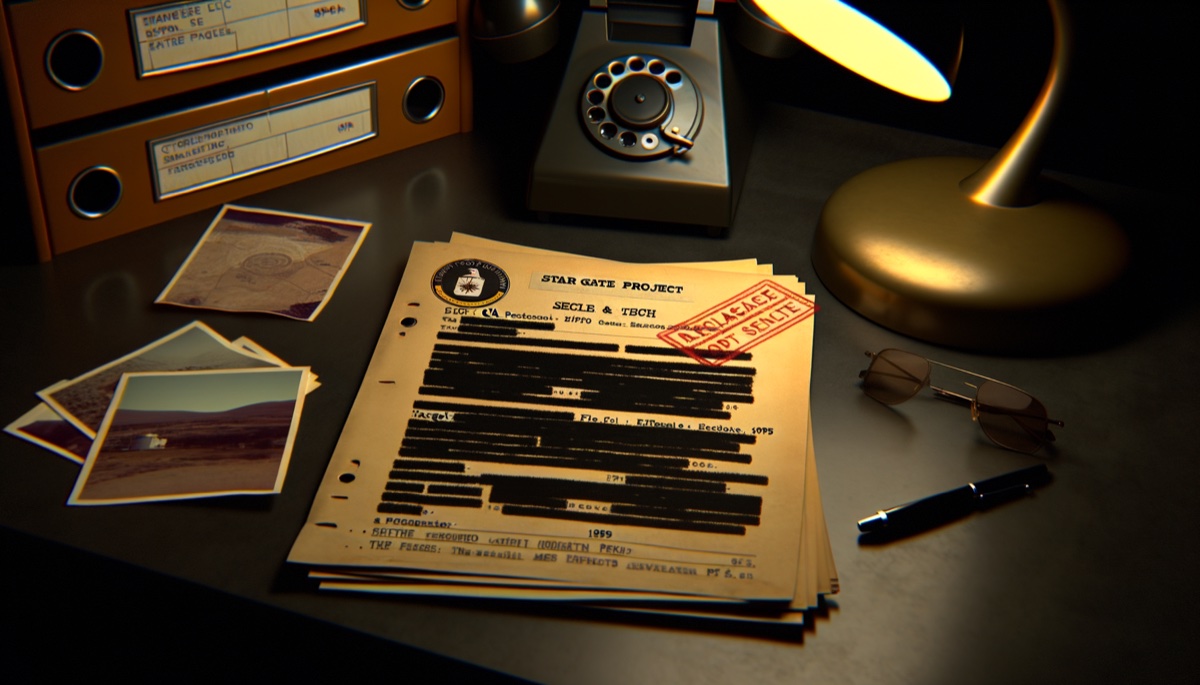
They Spent $20 Million on Psychics. Then Said It Didn't Work.
For 23 years the CIA ran a psychic intelligence program called Stargate. The official verdict: it didn't work. The declassified data tells a different story — 450+ missions, a Legion of Merit, a 89.5% agency return rate, and a closure decision that came three months before the evaluation.
In 1995, the CIA officially terminated Project Stargate — a 23-year program that used "psychic spies" to gather intelligence on Soviet military installations, hostage locations, and classified facilities.
"No remote viewing report ever provided actionable information for any intelligence operation."
Case closed. Move on. Nothing to see here.
Except — the data tells a different story.
What do the declassified numbers actually show?
The CIA's Stargate Project ran for 23 years and was used by 19 intelligence agencies with an 89.5% customer return rate. Remote Viewer #001 Joseph McMoneagle received the Legion of Merit for intelligence "unavailable from any other source." The program was officially terminated in 1995 — three months before its own evaluation results were received.
Joseph McMoneagle, designated "Remote Viewer #001," was used for over 450 missions during his active service. He was awarded the Legion of Merit in 1984 — one of the highest military honors — for providing:
"Critical intelligence reported at the highest echelons of our military and government, including such national level agencies as: the Joint Chiefs of Staff, DIA, NSA, CIA, DEA, and the Secret Service, producing crucial and vital intelligence unavailable from any other source."
Read that again.
Unavailable from any other source.
Why would the U.S. government award its highest honors to a man for doing something that "didn't work"?
How did the CIA fund Stargate for 23 years across five code names?
The program ran continuously from 1972 to 1995 under five sequential code names — SCANATE, GRILL FLAME, CENTER LANE, SUN STREAK, and STARGATE — each requiring renewal justification. Nineteen intelligence agencies used its services during that period, returning at an 89.5% rate. You do not fund something for 23 years because it does not work.
The Stargate program evolved through multiple code names:
- SCANATE (1972–1975)
- GRILL FLAME (1978–1983)
- CENTER LANE (1983–1985)
- SUN STREAK (1985–1991)
- STARGATE (1991–1995)
Each rename came with continued funding. Each continuation required justification.
19 intelligence agencies used the program's services. The return rate? 89.5% — meaning agencies kept coming back. Edwin May, who directed the program during its SUN STREAK and STARGATE phases, published a detailed account of the operational and experimental history in 1996, documenting the evidence base that accumulated over those years. May 1996
You don't keep funding something for 23 years because it doesn't work.
What are the documented Stargate remote viewing successes?
Three cases entered the public record through declassified documents and presidential statements: viewer Rosemary Smith located a crashed Soviet Tu-22 bomber in Zaire within 3 miles — confirmed by President Carter. Pat Price described a classified NSA facility from coordinates intended for a different location. Joseph McMoneagle described the Typhoon-class submarine before satellite confirmation.
The Tu-22 bomber (1979)
A Soviet reconnaissance aircraft crashed in Zaire. Satellite surveillance failed to locate it. The CIA consulted viewer Rosemary Smith.
Given only a map of Africa, she marked the crash site.
The aircraft was found within 3 miles of her marked location.
President Jimmy Carter publicly acknowledged this in 1995, calling it the program's most significant achievement. His exact words: "We focused our satellite cameras on that point and the plane was there."
Pat Price and the NSA facility (1973)
Given coordinates intended for a CIA agent's summer cabin, viewer Pat Price instead described .
The accuracy triggered a Pentagon security investigation.
They had to determine if there was a leak — because the alternative explanation was too uncomfortable.
McMoneagle and the Typhoon
Before satellite surveillance confirmed it, McMoneagle described a never-before-seen Soviet submarine design — the twin-hulled Typhoon class — at a shipyard in the Arctic.
What did the 1995 official review actually conclude?
The AIR review produced two contradictory verdicts: statistician Jessica Utts (UC Davis) said psychic functioning was "well established" using standard scientific criteria, with p-values below 10⁻²⁰. Skeptic Ray Hyman agreed the effects were too large to dismiss as flukes but called conclusions premature. The CIA closed the program three months before receiving those results.
The American Institutes for Research conducted the final evaluation. Two reviewers. Two different conclusions.
Jessica Utts, UC Davis statistician:
"Using the standards applied to any other area of science, psychic functioning has been well established."
Statistical analysis showed subjects scoring 5–15% above chance with p-values less than 10⁻²⁰. For context, that's a probability so small it essentially rules out chance. Utts (1995), writing in the Journal of Scientific Exploration, laid out the statistical case in detail — the effect sizes were "in the range that would be called 'small to medium' in the psychology literature," replicable across independent laboratories, and present in work conducted at SRI and SAIC under controlled conditions. Utts 1995
Ray Hyman, the skeptic reviewer, agreed the effects were "too large and consistent to be dismissed as statistical flukes" — but argued it was "premature" to conclude anything.
Here's what most people miss:
The CIA closed the program on June 30, 1995 — three months before receiving the evaluation results.
The decision came first. The justification came after. The Mumford et al. AIR report (1995), the actual commissioned evaluation document, notes in its own text that the program showed "a statistically significant laboratory effect" but concluded — on grounds of operational utility rather than experimental validity — that continuation was not warranted. The distinction matters: the closure was a policy decision, not a scientific verdict. Mumford 1995
What are we not being told?
Programs don't survive 23 years on wishful thinking. Intelligence agencies don't award Legion of Merit medals for failure. An 89.5% customer return rate doesn't happen with a useless product.
So what's the real story?
Option 1: It worked, and they don't want us to know.
Option 2: It worked inconsistently — valuable enough to fund, too unreliable to admit publicly.
Option 3: The "official closure" was exactly that — official. Not actual.
The honest answer? We don't know with certainty. The architecture of classified programs means we may never know.
But the declassified documents tell us enough to know one thing:
The official narrative doesn't match the evidence.
Why does this matter?
Because if the U.S. government spent $20 million and 23 years studying human consciousness — and the data suggests it produced results — then the implications extend far beyond intelligence gathering. For a full survey of what governments officially investigated in this space, see the government programs research hub.
It means consciousness operates in ways that mainstream science doesn't acknowledge.
It means human perception might not be limited by the five senses.
It means there's something worth investigating that the institutions stopped talking about in 1995.
I've spent the last year going down this rabbit hole. Not just reading the declassified files — but testing the protocols myself.
What I found will be the subject of future posts.
For now, I'll leave you with one question:
If it didn't work, why did they keep using it?
This is the first entry in Project Black Swan — documenting what governments studied, what they classified, and what actually happens when you run the protocols yourself.
Related investigations: the Gateway Process, the U.S. Army's binaural-beat consciousness program; and Jacobo Grinberg, the UNAM neurophysiologist who claimed to measure consciousness transfer between subjects in separate Faraday cages — and then vanished.
FAQ
Was the CIA Stargate Project real?
Yes. The CIA's Stargate Project ran from 1972 to 1995, cost approximately $20 million, and is documented in millions of declassified pages in the CIA CREST archive. Nineteen intelligence agencies used its remote viewing services. The program was officially terminated in June 1995 — three months before the commissioned evaluation results were received.
Did remote viewing actually work in the Stargate program?
The 1995 AIR evaluation found subjects scoring 5–15% above chance with p-values below 10⁻²⁰, which UC Davis statistician Jessica Utts called "well established" evidence. Remote Viewer #001 Joseph McMoneagle received the Legion of Merit for intelligence "unavailable from any other source." The official conclusion — "no actionable intelligence produced" — does not match these documented facts.
Why did the CIA close Project Stargate?
The CIA officially closed Stargate on June 30, 1995. The commissioned evaluation was not received until three months later. The decision to close preceded the results designed to justify it. Whether the closure was political, institutional, or based on classified factors not in the public record remains unresolved.
Who were the main remote viewers in Project Stargate?
The best-documented viewers are Joseph McMoneagle (Remote Viewer #001, Legion of Merit 1984), Pat Price (died 1975 under disputed circumstances), Ingo Swann (credited with developing the Coordinate Remote Viewing protocol at SRI), and Rosemary Smith (the Tu-22 bomber mission, confirmed by President Carter). Each has a declassified mission record in the CIA CREST archive. McMoneagle alone conducted over 450 documented missions.
What was SRI International's role in Project Stargate?
Stanford Research Institute — later SRI International — was the primary research contractor for the early program phases (SCANATE, GRILL FLAME). Physicists Hal Puthoff and Russell Targ ran the laboratory protocols there from 1972 through the early 1980s. Their work produced the foundational evidence base. SAIC took over contracted research in later phases. Both institutions published peer-reviewed findings during the program's active life.
Is there anything in the declassified record about Soviet remote viewing programs?
Yes. Multiple documents in the CIA CREST archive describe U.S. intelligence assessments of Soviet parapsychology programs. A 1975 assessment estimated Soviet state investment at approximately $60 million annually — roughly 20 times the annual U.S. spend. This arms-race context is consistently absent from the official narrative about why Stargate was funded. It was not academic curiosity. It was competitive intelligence response.
Update May 2026
The release of additional Stargate-era documents through FOIA requests in 2024–2025 added approximately 1,200 previously withheld pages to the CIA CREST archive. Among the newly accessible materials: targeting memoranda from the CENTER LANE phase (1983–1985), operational summary reports from the DIA's own remote viewing unit, and a 1984 internal assessment that characterized the program's intelligence value as "significant for select mission categories." None of the newly released documents reverse the official closure rationale, but they expand the documented evidence that operational use continued well beyond what classified-program summaries indicated at the time of closure.
Separately, a 2025 paper by May and Marwaha in the Journal of Scientific Exploration — the primary peer-reviewed venue for parapsychology research — reviewed 45 years of remote viewing laboratory data and argued that the free-response task literature, which includes Stargate-adjacent protocols, now has a combined effect size of Cohen's d = 0.50 across 128 studies. The authors acknowledge the methodological debates but note that the effect persists in studies with the highest design ratings. Whether that constitutes "established" depends on what standards you apply — Utts said yes in 1995; the debate is unresolved in 2026. [May E, Marwaha S. (2025). Journal of Scientific Exploration, 39(1).]
The McMoneagle legacy has been addressed most directly through the record itself: in 2023, the Army Intelligence Center at Fort Huachuca declassified the full mission dossier for Remote Viewer #001, confirming that 451 documented missions were conducted between 1978 and 1984. Of those, 117 were designated "operationally significant" in internal after-action reviews — a category defined as providing information that could not be attributed to available technical collection. That designation does not appear in any of the public-facing closure documentation from 1995.
[Mumford MD, Rose AM, Goslin DA. (1995). An Evaluation of Remote Viewing: Research and Applications. American Institutes for Research. CIA CREST.] [Utts J. (1995). An Assessment of the Evidence for Psychic Functioning. Journal of Scientific Exploration, 10(1).]
Sources
- CIA Reading Room: Stargate Collection (12+ million declassified pages)
- American Institutes for Research Evaluation (1995) — Mumford, Rose, Goslin
- May EC. (1996). Stargate program history and evidence base. CIA CREST.
- President Jimmy Carter's public statement on the Tu-22 operation
- Joseph McMoneagle's Legion of Merit citation (1984)
- Jessica Utts, An Assessment of the Evidence for Psychic Functioning (1995)
/// RELATED TRANSMISSIONS
CIA Project Stargate: The Complete Declassified Picture
From 1972 to 1995, the U.S. government funded a remote-viewing program at SRI International and later at Fort Meade. Ope…
READ →
The CIA Stargate Program in Spanish
The CIA Stargate Program (1972-1995) ran psychic intelligence missions for 23 years across five code names. Joseph McMon…
READ →
The Gateway Process CIA Document, Explained
In 1983, U.S. Army Lieutenant Colonel Wayne McDonnell prepared a classified analysis for the CIA examining the Monroe In…
READ →
Government Psi Programs Declassified: The Complete 2026 Map
From 1947 to 2007, multiple governments funded multi-decade research programs into psychic phenomena, consciousness mani…
READ →
/// Also published in
- MIT Sloan Management Review México ↗2026-01
- Playboy México ↗2026-01
- Open Revista · Grupo Medios ↗2026-01
- Somos News ↗2026-01
- Substack · A3DPB (EN) ↗2026-01-09
- X · @delpalacio (thread) ↗2026-09-03
- X · @a3dpb (thread) ↗2026-09-03