The U.S. Army Designed a Program to Escape Time and Space. Then They Buried It.
In 1983, Lt. Col. Wayne McDonnell was tasked with evaluating the Monroe Institute's Gateway Process — a training program for hemispheric synchronization and out-of-body states. His 28-page report referenced quantum mechanics, holographic universe theory, and consciousness research. It concluded the program worked. Then it was classified for 20 years, with one page missing.
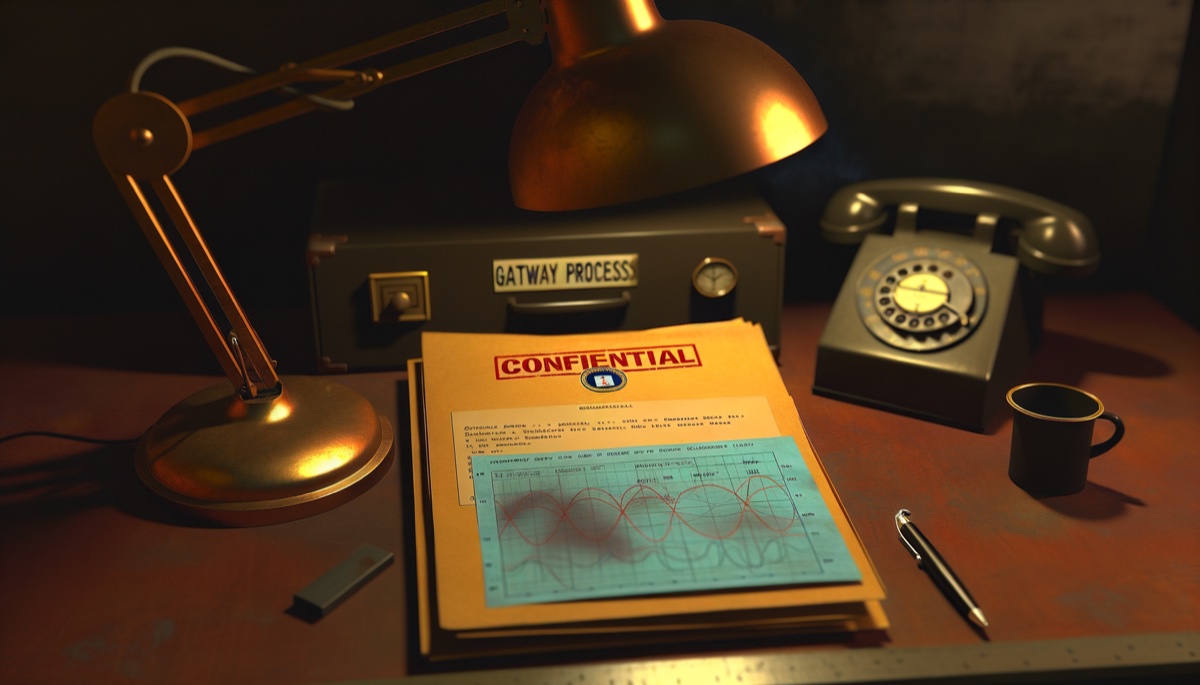
In 1983, a Lieutenant Colonel was tasked with evaluating a training program promising to teach soldiers how to escape the confines of time and space — literally, not metaphorically. The resulting 28-page report referenced quantum mechanics, holographic universe theory, and consciousness research, concluding the program worked.
It was then classified for 20 years.
Who was Robert Monroe and how did the Gateway Process begin?
Robert Monroe was a radio broadcasting executive in Virginia running a successful company producing programs for 28 stations nationwide. In 1958, while researching sound patterns' effects on consciousness for sleep-learning applications, he began spontaneously leaving his body in full waking consciousness.
Monroe meticulously documented his experiences over the next decade, developing protocols to induce and control these states. In 1971, he published Journeys Out of the Body — the first systematic documentation of out-of-body experiences by someone approaching the subject as an engineer rather than a mystic.
How does Hemi-Sync binaural beat technology work?
Hemi-Sync works by playing two slightly different frequencies into each ear — for example, 400 Hz left and 410 Hz right — causing the brain to perceive a 10 Hz "phantom" beat and entrain toward it. Monroe called this hemispheric synchronization. By layering multiple binaural frequencies, the Monroe Institute could guide the brain through precisely defined consciousness states with repeatable results.
Monroe discovered that specific audio frequencies could reliably induce altered states of consciousness. When two slightly different frequencies are played into each ear — say, 400 Hz in the left and 410 Hz in the right — the brain perceives a third "phantom" frequency: the 10 Hz difference. This phenomenon, called binaural beats, causes the brain to entrain toward that frequency.
Monroe called his technology Hemi-Sync (hemispheric synchronization). By carefully layering multiple binaural frequencies, he could guide the brain through precise states of consciousness with unprecedented reliability. This was frequency engineering for the human mind.
In 1974, Monroe established The Monroe Institute in Virginia's Blue Ridge Mountains — a research facility dedicated to exploring consciousness technology applications.
Why did the U.S. Army commission a classified analysis of the Gateway Process?
By 1983, after sending personnel to the Monroe Institute since 1978, the U.S. Army commissioned Lt. Col. Wayne McDonnell to formally evaluate the Gateway Process. McDonnell's 28-page report concluded the program produced real altered-consciousness states, referenced quantum mechanics and holographic universe theory, and was classified for 20 years.
In 1978, elements of the U.S. military began sending personnel to the Monroe Institute for training. By 1983, the Army commissioned an official assessment. Lieutenant Colonel Wayne M. McDonnell of the U.S. Army Intelligence and Security Command was assigned to analyze the Gateway Process — Monroe's flagship consciousness exploration program.
McDonnell participated in Gateway training, interviewed previous participants, and consulted scientific literature. His report stated:
"The underlying intent of this paper is to challenge the reader to suspend disbelief long enough to allow for an objective evaluation of the data presented."
McDonnell drew on biomedical models of Israeli scientist Itzhak Bentov, incorporated quantum mechanics and holographic universe theory, and analyzed neurological effects of binaural beats and hemispheric synchronization. His professional conclusion:
"Fundamentally, the Gateway experience is a training system designed to bring enhanced strength, focus and coherence to the amplitude and frequency of brainwave output between the left and right hemispheres so as to alter consciousness, moving it outside the physical sphere so as to ultimately escape even the restrictions of time and space."
The report recommended practical applications for military intelligence gathering, including — in McDonnell's own phrasing — possibilities of encountering "intelligent, non-corporeal energy forms when time-space boundaries are exceeded."
This is a U.S. Army document.
What are the Gateway Process Focus Levels and what does each one do?
The Gateway Process uses six principal Focus Levels accessed through specific Hemi-Sync audio frequencies: Focus 10 (mind awake, body asleep), Focus 12 (expanded awareness, early remote viewing), Focus 15 (no linear time perception), Focus 21 (edge of time-space), and Focus 27 and beyond (non-physical territory consistent with near-death experience reports).
The Gateway Process is a systematic curriculum for navigating consciousness, built around "Focus Levels" accessed through specific Hemi-Sync frequencies:
- Focus 10 — "Mind Awake, Body Asleep." Physical body enters deep relaxation while awareness remains conscious.
- Focus 12 — "Expanded Awareness." Consciousness expands beyond physical body signals; remote viewing capabilities begin emerging.
- Focus 15 — "No Time." Linear time is no longer experienced; past-life exploration and precognitive perception reportedly occur.
- Focus 21 — "The Bridge." The edge of time-space, described as the bridge between physical reality and other dimensions.
- Focus 27 and beyond — territory expands into "The Park" (a non-physical location appearing consistently in near-death experience reports) and further levels mapping cluster consciousness, the "I-There" (roughly equivalent to the higher self), and ultimately "the Absolute."
Monroe and his researchers created a reproducible map of consciousness states, each accessible through specific audio protocols and producing consistent effects across thousands of participants.
What is missing from page 25 of the declassified Gateway Report?
Page 25 — the final page of the 1983 McDonnell report containing conclusions, practical applications, and recommendations — was missing from the CIA's declassified release in 2003. FOIA requests yielded only the CIA's claim that the page was "missing from their archives." In 2021 it reportedly surfaced, but questions about completeness and authenticity remain open.
The Gateway Report was classified until 2003. When finally released through the Freedom of Information Act, one page was missing: page 25 — the final page containing conclusions, practical applications, and recommendations.
For years, researchers noted the gap. FOIA requests were filed. The CIA claimed the page was "missing from their archives."
In 2021, the page reportedly surfaced. Questions remain about authenticity and completeness. The content included recommendations for operational Gateway Process use and discussion of what McDonnell called "the absolute" — the universe as a self-aware hologram and consciousness as the fundamental substrate of reality.
What evidence exists that the Gateway Process produced real results?
Joseph McMoneagle, designated "Remote Viewer #001," trained at the Monroe Institute and participated in 450+ remote viewing missions for U.S. intelligence, receiving the Legion of Merit for providing "intelligence critical to national defense… not available from any other source."
Multiple peer-reviewed studies documented that Hemi-Sync technology produces measurable EEG changes, including documented effectiveness as a partial replacement for fentanyl during surgical procedures.
Skip Atwater, who initiated and ran the U.S. Army's remote viewing program for a decade, spent the rest of his career at The Monroe Institute, eventually becoming its President.
Intelligence officers trained there. Published research followed. The story of Gateway is not rumor — it's a paper trail.
What makes the Gateway Process different from other consciousness research?
The Gateway Process differs from most consciousness research because it is operational, not theoretical. The Monroe Institute doesn't ask believers; it invites experimentation. Thousands have reported out-of-body experiences, remote viewing accuracy, contact with non-physical intelligences, and information about verifiable events unknown through normal means.
The U.S. intelligence community funded this research for nearly two decades, sent career intelligence officers for training, and classified the results.
Then, in 2003, they released the report with page 25 missing.
What pattern connects Stargate, Gateway, and Wim Hof?
Three programs. Three decades. Same pattern: research, results, suppression.
Project Stargate ran psychic intelligence — 23 years, 19 intelligence agencies, an 89.5% customer return rate. Gateway ran consciousness engineering. And the next piece is about a man who taught ordinary people to control their autonomic nervous system — the so-called involuntary one — on command.
The question isn't whether consciousness does strange things under specific conditions.
The question is why we stopped publishing what we know.
This investigation is part of the government programs research cluster, documenting what official programs studied, classified, and declined to publish. For a parallel thread in consciousness research: Jacobo Grinberg, the UNAM neurophysiologist who measured correlated EEG between isolated meditating subjects — and then vanished.
FAQ
What is the CIA Gateway Process?
The Gateway Process is a binaural-beat meditation curriculum developed by Robert Monroe at the Monroe Institute in Virginia, starting 1971. In 1983, U.S. Army Lt. Col. Wayne McDonnell evaluated it in a 28-page report — classifying it for 20 years — and concluded it was "designed to bring enhanced strength, focus and coherence to the amplitude and frequency of brainwave output" and could move consciousness "outside the physical sphere so as to ultimately escape even the restrictions of time and space."
Is the Monroe Institute's Hemi-Sync technology scientifically validated?
Multiple peer-reviewed studies have documented that Hemi-Sync produces measurable EEG changes. The most striking clinical finding: Hemi-Sync served as a partial replacement for fentanyl during surgical procedures in documented medical use. The U.S. Army's McDonnell report described hemispheric synchronization as producing "a condition of coherence, harmony and resonance between left and right hemispheres."
What happened to page 25 of the Gateway Report?
Page 25 was the final page of the 1983 McDonnell analysis, containing conclusions and practical recommendations. When the CIA released the report under FOIA in 2003, that page was absent. The CIA stated it was "missing from their archives." In 2021 the page reportedly surfaced online; its authenticity and completeness remain disputed among researchers.
Sources
- McDonnell, W. M. (1983). Analysis and Assessment of Gateway Process. U.S. Army Intelligence and Security Command. Declassified 2003.
- Monroe, R. A. (1971). Journeys Out of the Body. Doubleday.
- Monroe, R. A. (1985). Far Journeys. Doubleday.
- Monroe, R. A. (1994). Ultimate Journey. Doubleday.
- Atwater, F. H. (2001). Captain of My Ship, Master of My Soul. Hampton Roads.
- Peer-reviewed studies on binaural beats and hemispheric synchronization (various journals, 1990–2020)
- CIA Reading Room: FOIA-released Gateway Process documents
/// RELATED TRANSMISSIONS
The Gateway Process CIA Document, Explained
In 1983, U.S. Army Lieutenant Colonel Wayne McDonnell prepared a classified analysis for the CIA examining the Monroe In…
READ →
Government Psi Programs Declassified: The Complete 2026 Map
From 1947 to 2007, multiple governments funded multi-decade research programs into psychic phenomena, consciousness mani…
READ →
CIA Project Stargate: The Complete Declassified Picture
From 1972 to 1995, the U.S. government funded a remote-viewing program at SRI International and later at Fort Meade. Ope…
READ →
MK-ULTRA's Consciousness Experiments: What Was Actually Tested
Project MK-ULTRA (1953-1973) is widely known as the CIA's mind-control program. Less widely known is its substantial foc…
READ →
/// Also published in
- Substack · A3DPB (EN) ↗2026-01-10
- Substack · VENUS (ES) ↗2026-08-27
- X · @a3dpb (thread) ↗2026-08-31