Tummo Meditation: Harvard's Research on Tibetan Heat Generation
In 1981 and again in 2002, Herbert Benson's Harvard team measured Tibetan monks practicing g-tummo meditation in the Himalayas. The monks raised their finger and toe temperatures by 17°F (9.4°C) while sitting in 40°F (4°C) rooms. In a follow-up, they dried wet sheets draped over their bodies in sub-freezing temperatures. This article reviews the original Nature paper, the 2013 PLOS ONE replication, and what the data actually establishes.
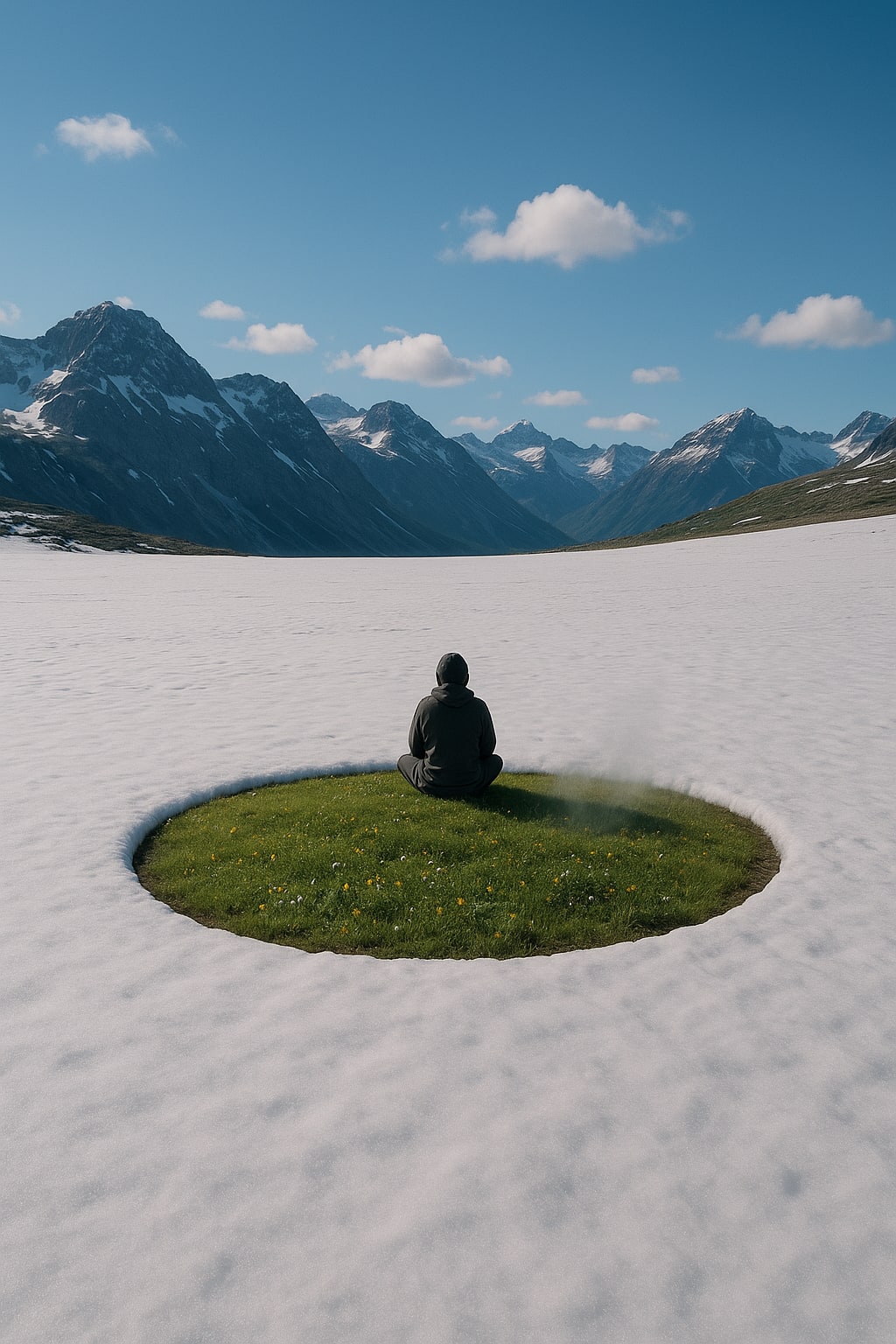
In February 1981, Herbert Benson — the Harvard cardiologist who had coined the term "relaxation response" — flew to Upper Dharamsala in the Indian Himalayas with measurement equipment and the Dalai Lama's permission to test what Tibetan Buddhists had been claiming for a thousand years: that advanced meditators could generate measurable physical heat through a practice called g-tummo.
What he found became one of the few peer-reviewed measurements of an extraordinary physiological capacity that, until then, Western science had relegated to anthropology footnotes.
What is g-tummo?
G-tummo (Tibetan for "inner fire" or "fierce woman") is a tantric meditation practice from the Vajrayana Buddhist tradition. It combines three coordinated elements:
- Specific breathing pattern — most commonly "breath of vase" (bum-pa-can), which involves holding the breath in the lower abdomen while contracting the pelvic floor and diaphragm to compress air into a "vase" shape
- Visualization — vivid mental imagery of a flame at the navel center, growing and spreading throughout the body
- Isometric muscular work — coordinated muscular contractions of the abdomen, pelvic floor, and diaphragm
The practice is part of a larger system known as the Six Yogas of Naropa, and is considered foundational training for advanced Vajrayana practice.
[Mullin GH. (1997). Tsongkhapa's Six Yogas of Naropa. Snow Lion Publications.]
What did Benson's 1982 Nature paper show?
Benson, Lehmann, Malhotra, Goldman, Hopkins, and Epstein published Body temperature changes during the practice of g-Tum-mo yoga in Nature (1982). The experimental setup:
- Subjects: 3 advanced g-tummo practitioners with at least 6 years of training
- Setting: Unheated room in Dharamsala, ambient temperature ~40°F (4°C)
- Measurements: Surface temperature sensors on fingers and toes; rectal temperature for core
- Procedure: Subjects practiced g-tummo for ~45 minutes while measurements were continuously recorded
The results:
- Finger temperatures rose by up to 17°F (9.4°C) during the practice
- Toe temperatures rose by up to 15°F (8.3°C)
- Core (rectal) temperature did NOT rise significantly — in fact, dropped slightly in some subjects
- The peripheral temperature increases reversed within ~30 minutes after the practice ended
The finding was extraordinary because typical human physiology under cold exposure responds with vasoconstriction in the extremities (the body conserves heat by reducing blood flow to fingers and toes). These monks were doing the opposite: voluntarily inducing peripheral vasodilation in cold conditions.
What was the 2002 follow-up?
In 2002, Benson and colleagues returned to Dharamsala for a follow-up study that has not been formally published as a peer-reviewed paper but was documented extensively:
- Monks sat in sub-freezing temperatures (~30°F / -1°C) wrapped in sheets that had been soaked in 49°F (9°C) water
- Within 3-5 minutes, the monks were generating enough heat to begin drying the sheets via steam
- Multiple sheets were dried over the course of several hours
- The monks remained alert and stable throughout
This is the source of the widely-circulated "monks drying wet sheets" reports. The 2002 work was filmed but not published in a peer-reviewed journal; this remains a methodological gap that critics correctly point to.
What did Kozhevnikov 2013 add?
Maria Kozhevnikov (Singapore) and colleagues published Neurocognitive and Somatic Components of Temperature Increases during g-Tummo Meditation: Legacy and Advanced Practitioners in PLOS ONE (2013). This is the most rigorous replication to date:
Study design:
- Subjects: Two groups — 11 g-tummo practitioners from Qinghai, China + 11 Western non-meditator controls trained briefly in the breathing technique
- Measurements: Continuous core (sublingual + rectal) and peripheral temperatures, plus EEG
- Comparison: Forceful breath-of-vase vs gentle breath-of-vase vs visualization-only
Findings:
- Forceful breath-of-vase produced core temperature increases of up to 1.2°C (reaching ~38.3°C — mild fever range)
- Gentle breath-of-vase alone did NOT raise core temperature
- Visualization combined with forceful breath produced LONGER sustained temperature elevation than forceful breath alone
- Western controls trained briefly in the technique could also raise core temperature — though less reliably and to a smaller degree
The key insight: forceful breath-of-vase appears to be the primary physiological driver, while visualization extends and sustains the response.
[Kozhevnikov M, Elliott J, Shephard J, Gramann K. (2013). Neurocognitive and Somatic Components of Temperature Increases during g-Tummo Meditation: Legacy and Advanced Practitioners. PLOS ONE, 8(3), e58244.]
What is the proposed mechanism?
A multi-system explanation:
1. Sympathetic nervous system activation. Forceful breath-of-vase appears to trigger compensatory catecholamine release similar to what Kox et al. documented in Wim Hof Method practitioners. Catecholamines drive metabolic heat generation.
2. Brown adipose tissue (BAT) thermogenesis. BAT is metabolically active fat tissue concentrated around the neck, shoulders, and spine that burns glucose to produce heat directly (rather than via muscular shivering). BAT activity is regulated by sympathetic activation. Adult humans have small but functional BAT depots, and these are activated by cold exposure + sympathetic stimulation.
3. Isometric muscular work. The vase-shaped breath hold involves sustained contraction of the abdominal wall, pelvic floor, and diaphragm. Sustained isometric work generates heat as a byproduct of muscular metabolism.
4. Vasomotor control. The peripheral temperature increases observed in 1982 suggest voluntary control over peripheral vasoconstriction/vasodilation, possibly mediated by the practiced shift in sympathetic balance.
5. Mental imagery and physiological priming. Kozhevnikov's finding that visualization extends the temperature response suggests cortical/imagery contributions to sustained autonomic shifts — consistent with broader research on mental imagery's effects on heart rate, skin conductance, and other autonomic markers.
What can we conclude?
Well-established:
- Trained g-tummo practitioners can voluntarily raise peripheral and core body temperature
- The peripheral temperature shift (9.4°C in fingers/toes) is qualitatively unusual for cold-exposed humans
- The core temperature shift (1.2°C) approaches mild fever range
- Forceful breath-of-vase is the primary driver; visualization is a sustaining modulator
- Non-meditators trained briefly can produce smaller versions of the effect
Not established:
- That the practice has therapeutic value outside the religious context
- That the magnitude observed in advanced practitioners is achievable for most people
- That the effects are mediated only by the proposed physiological mechanisms (alternative interpretations possible)
- That the 2002 wet-sheet demonstrations would replicate under controlled peer-reviewed conditions
Open questions:
- Long-term cardiovascular implications of repeatedly entering this state
- Whether BAT activation training generalizes (i.e., does practicing g-tummo make a person more cold-resistant outside the practice?)
- Whether neuroimaging during g-tummo would reveal patterns comparable to other advanced meditative states
How does this fit alongside Wim Hof?
There are interesting parallels and key differences:
| G-tummo | Wim Hof Method | |
|---|---|---|
| Origin | Tibetan Vajrayana, ~10th century | Dutch, 1990s-2000s |
| Primary breath | Vase-holds + retention | Hyperventilation cycles + retention |
| Measured outcome | Heat generation | Inflammation suppression |
| Visualization | Central (flame at navel) | Optional/light |
| Cold context | Practiced in cold conditions | Practiced before/during cold |
| Goal | Religious/spiritual development | Stress resilience |
These are different protocols developed in different traditions for different ends, but both converge on voluntary autonomic modulation. The underlying physiology overlaps substantially: catecholamine release, sympathetic activation, possible BAT involvement.
The Wim Hof story isn't separable from this longer lineage. Cold-exposure and breath-control practices for non-ordinary physiology predate the modern wellness era by ~1,000 years.
Does this validate "meditation can change your body"?
It validates a specific, narrow claim: trained meditative breath + visualization practices can produce measurable autonomic shifts. That is well-established.
It does NOT validate broader claims like:
- "Meditation cures disease"
- "Anyone can do this with enough effort"
- "Mental imagery alone produces these effects"
The strict reading: g-tummo demonstrates that voluntary control over normally-involuntary physiology is real, trainable, and substantial in trained practitioners. The mechanism is intelligible. The boundary of what's possible is being mapped.
How does this connect to the broader pillar?
Tummo sits within the Breathwork Science Evidence pillar as the most rigorously-documented case of voluntary thermogenesis through breath + imagery practice. The Wim Hof PNAS 2014 study anchors the inflammation-modulation evidence. Holotropic Breathwork evidence covers the long-duration, non-ordinary-state side of the spectrum.
Sources
- Benson H, Lehmann JW, Malhotra MS, Goldman RF, Hopkins J, Epstein MD. (1982). Body temperature changes during the practice of g-Tum-mo yoga. Nature, 295(5846), 234-236.
- Kozhevnikov M, Elliott J, Shephard J, Gramann K. (2013). Neurocognitive and Somatic Components of Temperature Increases during g-Tummo Meditation: Legacy and Advanced Practitioners. PLOS ONE, 8(3), e58244.
- Cromie WJ. (2002). Meditation Changes Temperatures: Mind Controls Body in Extreme Experiments. Harvard University Gazette.
- Mullin GH. (1997). Tsongkhapa's Six Yogas of Naropa. Snow Lion Publications.
- Cannon B, Nedergaard J. (2004). Brown adipose tissue: function and physiological significance. Physiological Reviews, 84(1), 277-359. — background on BAT thermogenesis mechanism
/// RELATED TRANSMISSIONS
Is Breathwork Scientifically Proven? The Complete 2026 Evidence Review
Breathwork has the strangest evidence profile in wellness research: a single PNAS paper (Kox et al. 2014) demonstrating…
READ →
Breathwork vs Meditation: What the Evidence Distinguishes
Both breathwork and meditation modulate autonomic state, reduce stress markers, and produce measurable EEG changes. But…
READ →
Manifestation Experiments With Evidence: The Three Mechanisms in Depth
The three scientifically supported mechanisms behind what manifestation teaches: implementation intentions (Gollwitzer,…
READ →
Grinberg and Quantum Mechanics: The Complete EPR-Brain Experiment
In 1994, Mexican neurophysicist Jacobo Grinberg-Zylberbaum published in Physics Essays a peer-reviewed experiment showin…
READ →